Anti-Woke as an Aesthetic: Beauty, Backlash and Conservative Womanhood
Leigh Douglas shares her insights. Her play, ROTUS, will soon be on stage in London.

Written by Leigh Douglas
In the wake of renewed “anti-woke” rhetoric across the UK and US, writer and performer Leigh Douglas examines how conservative women are turning backlash into a personal brand - reframing identity politics as empowerment, authenticity and even feminist rebellion.
You know who is truly overlooked in today’s society? Conventionally attractive, straight-sized, heterosexual, cisgendered, Christian white women. Or so the conservative women of the Make America Hot Again movement would have us believe. Yes, that’s correct, the conservative hot women of America are feeling oppressed.
The stated mission of The Conservateur, an online conservative women’s lifestyle publication currently making waves in Washington DC by hosting Make America Hot Again parties, is to “restore long-lost moral and aesthetic refinement.” They pride themselves on their “steadfast commitment to excellence, faith, and virtue – even when it’s not in vogue.” What becomes clear quite quickly, after even a cursory glance at their rhetoric, is that not only are these women laying claim to hotness as a conservative trait, they also believe that being hot makes you morally superior as a woman. They are unguarded in making an explicit connection between beautiful aesthetics and religious virtue. That is, being hot makes you a better wife, a better mother, a better woman and a more patriotic American. To these women, sweatpants are forbidden fruit, an evil temptation to guard against, lest they become fallen un-hot women.
They see themselves as righteous crusaders and warn against an “uglification of culture” but what exactly does that mean? The fashion and beauty industries have had a reckoning and it’s making these conservative women itchy. Diverse voices are being heard in beauty and fashion through breakthrough social media influencers with followings large enough to have real economic power. These influencers are championing diversity and holding brands accountable for providing inclusive sizing, makeup shades, and adaptive designs. As a society, our conception of beauty has expanded in the quarter-century since the millennium. A multitude of voices are rallying to expand our understanding of beauty beyond the aesthetics of the 1990s supermodel. In pop culture, advertising and editorial fashion, space has been made for a plurality of beauties.
This is making conservative women deeply unhappy.
When fashion magazines spotlight diverse forms of beauty, whether that be in featuring curvy or plus-size models, queer aesthetics, disabled models, or non-Eurocentric aesthetics, they refer to these publications as “glamorising evil.” Barely beneath the surface of this attitude is a deep-rooted racism, homophobia, fatphobia and ableism. Like imperial Tudor queens, the women of Make America Hot Again believe they were given the divine right to rule over aesthetics, and they feel their crown is being usurped. Needless to say, they are not handling this very well.
There is no doubt that the conservative women’s movement presents an image that is aspirational to many women. They dress beautifully. I, riddled with self-loathing and lefty liberal guilt, found myself looking up where one of their dresses was from after it came up on my For You page. I have to admit, as a femme lesbian, the classically feminine Rachel Green in Ralph Lauren aesthetic is appealing to me. I do not, however, believe dressing this way makes me morally superior to my girlfriend whose aesthetic is more Justin Bieber does grungecore or my best friend who, as a bisexual cisgender woman, could easily on any given day be mistaken for a member of the 00s boyband, Hanson. Dear reader, I will not have it said that either my girlfriend or my best friend are anything less than super-hot. Androgyny has not been forced on either of them by the woke agenda, it is a celebratory form of self-expression hard-earned through years of their lives feeling uncomfortable in their clothes while attempting to fulfil the societally sanctioned feminine aesthetic I covet.
To the women of Make America Hot Again however, femininity has become a form of resistance to what they see as the erasure of “traditional beauty.” As dark-skinned women, genderqueer people, fat women, butch women and disabled women embrace seeing themselves represented, often for the first time, by the fashion and beauty industries, slim conservative white women see this inclusion as an eradication of their culture. They wish to return to the world in which their beauty was the only beauty and alternative fashion was underground where they didn’t have to see it.
Their discomfort at simply being presented with styles, fashions and trends that don’t speak to them personally has somehow allowed them to create the narrative that femininity is a feminist cause. In actual fact, no one is trying to stop them from dressing however they want. No one is trying to outlaw cowboy boots, Mormon waves, or sparkly cross necklaces. While queer people were legislated against during the lavender scare for wearing “opposite-gender clothing” in the 1950s and 60s, these women will never suffer public shaming, legal recriminations or even a dirty look in the street for wearing a polka-dot dress whenever they like.
The source of conservative women’s fervour on this topic becomes clearer however when we situate it in the context of the Christian missionary. Women must dress to attract and keep a conservative husband so that they can live within a fundamentalist Christian family structure. Living inside a scarcity mindset for female success, they harken back to the vision of 1990s supermodels as the standard for beauty and fashion because it is available to a smaller pool of mostly white, rich, able-bodied women. By adhering to patriarchal beauty standards, they tell me, I will get closer to God as a wife and mother. They feel free to call things “ugly” because the word is linked in their rhetoric to moral deviance. You can pass off demanding conformity as empowerment if conformity confers pretty privilege. In promoting their aesthetic and making it aspirational to women like me, it is no exaggeration to say they are also seeking to convert me to an American fundamentalist Christian way of living.
Yet, the fashion and beauty industries have always been fuelled by queer, black and brown creativity, whether these artists were visible in the advertising or not, whether they were credited or not. The aesthetic these women celebrate as “traditional” was once genuinely transgressive and no doubt originated with POC and queer change-makers in the industry. As a fellow straight sized, white, feminine (though admittedly gay) woman, I believe these women have an important lesson to learn: being de-centred is not the same as being suppressed and encountering other ways of being is not the same as being erased.
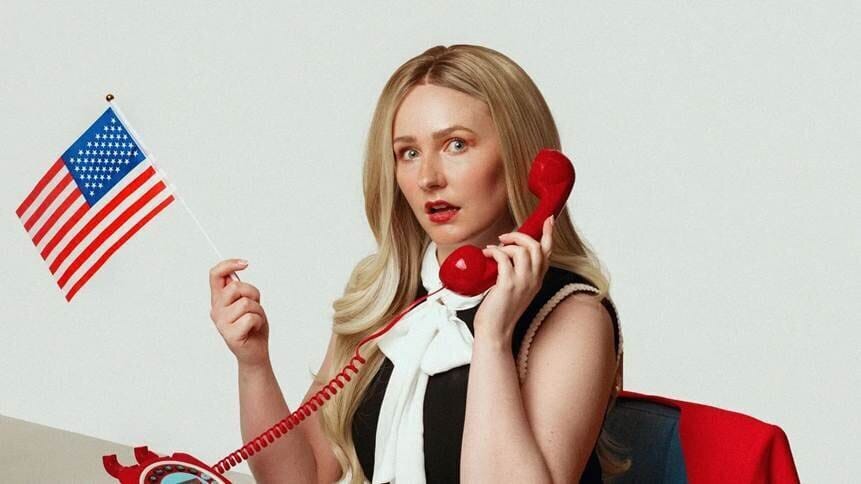
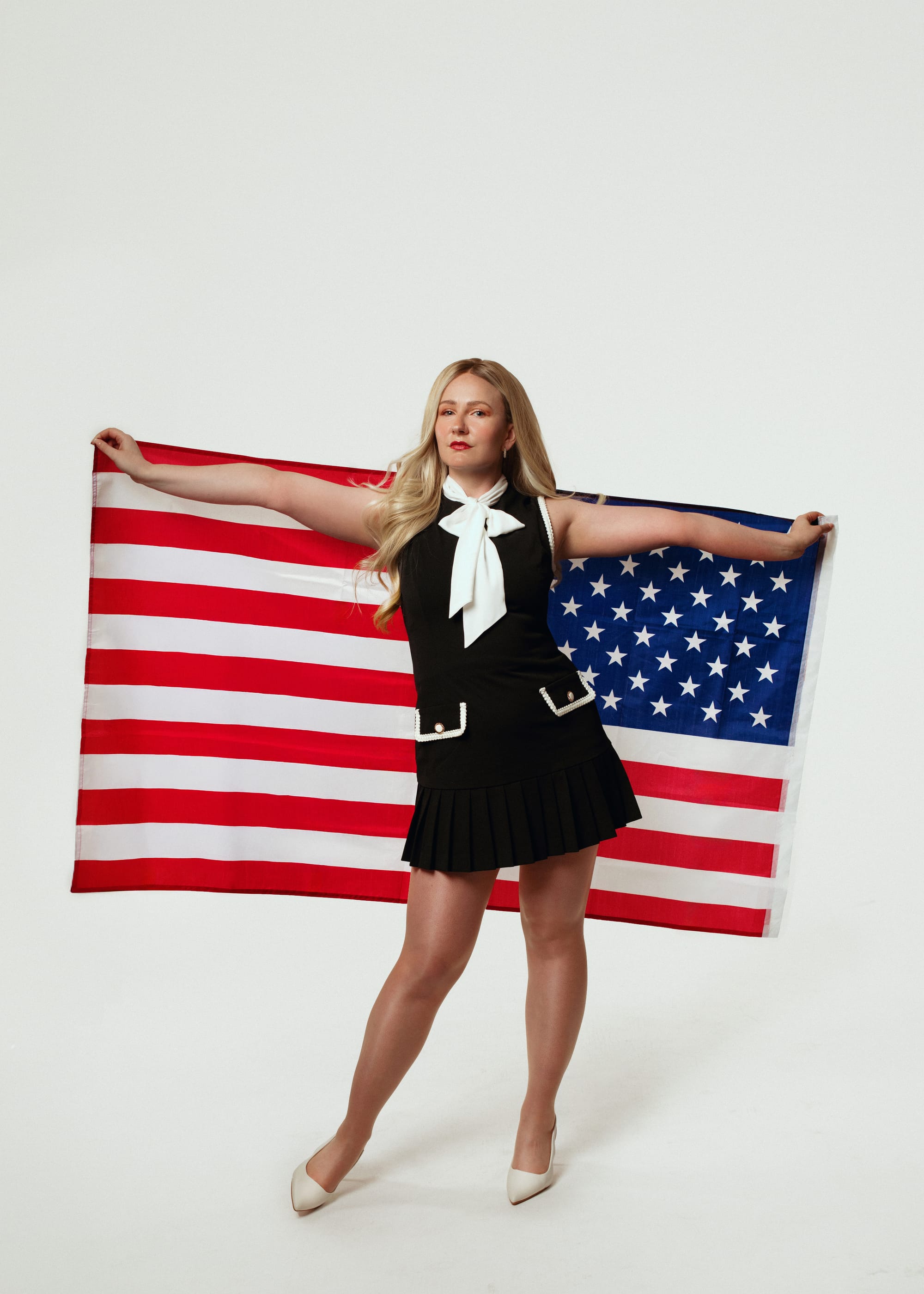
ROTUS: Receptionist of The United States
Leigh Douglas brings her satirical show ROTUS: Receptionist of The United States to the London stage.
The show follows Chastity Quirke – White House receptionist (Receptionist Of The United States), ex-sorority chapter president, and staunch Republican – as she navigates a sudden political and personal reckoning. Fiercely loyal to the President and determined to rise through the ranks, Chastity’s blind faith in the system begins to falter as she’s forced to confront the consequences of her unwavering allegiance.
ROTUS interrogates the pressures, contradictions and moral consequences faced by young women operating within hardline conservative politics, particularly the role white women have played in upholding patriarchal power structures.
While the story is fictional, it draws heavily on the lived experiences of real women, weaving together stand-up, theatre, and cabaret to paint a portrait of a woman caught between loyalty, ambition, and conscience.
ROTUS will run at the Park Theatre in London from 20 January until 7 February
The NSFW edition
If you want to admire some man-on-man action, our NSFW edition gives you every inch.
Sign in and check out our NSFW content - it's free!
 Gaydar