What to watch: Baby
A film by Marcelo Caetano that immerses us in the streets of São Paulo.

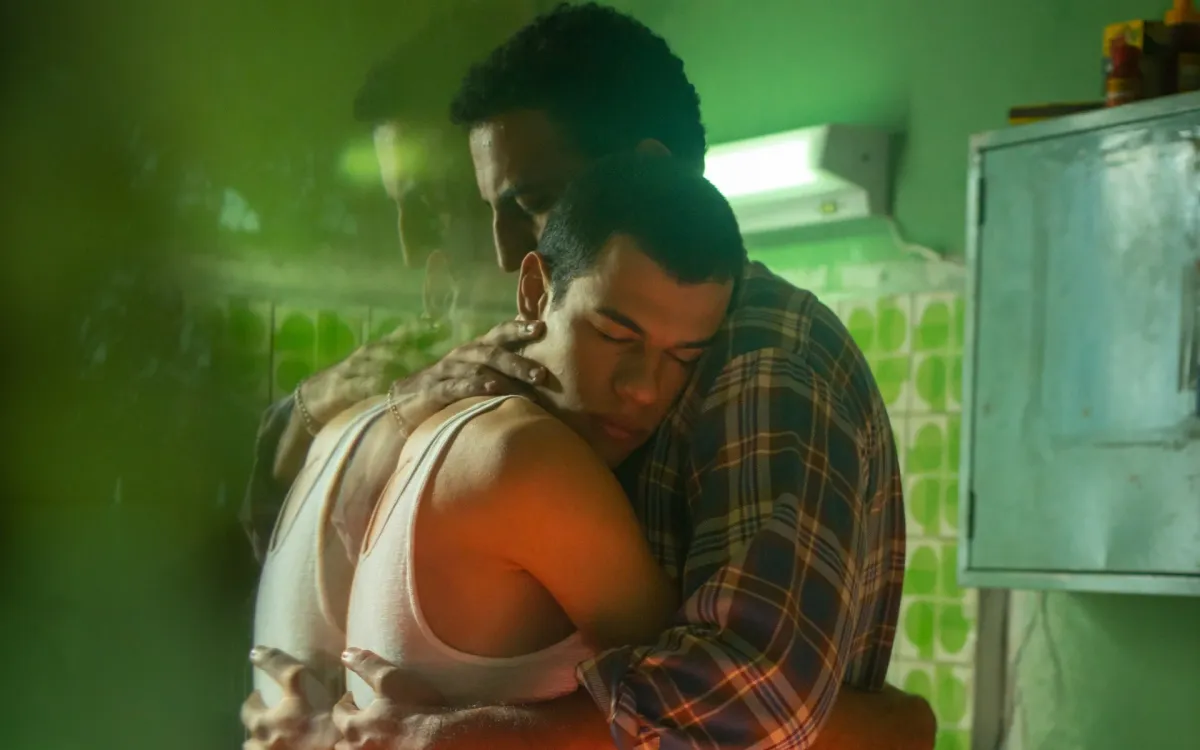
The latest film from Marcelo Caetano is Baby.
After being released from a juvenile detention centre, 18-year-old Wellington (João Pedro Mariano) finds himself alone and adrift on the streets of São Paulo, without any contact from his parents and lacking the resources to rebuild his life.
At a porn cinema he encounters Ronaldo (Ricardo Teodoro), who teaches him new ways of surviving. Gradually, their working relationship becomes a tumultuous passion.
Marcelo Caetano on How To Date Men
For our podcast, How To Date Men, we caught up with Marcelo Caetano for a behind-the-scenes look at Baby.
In the conversation, we discuss movement, age-gaps, and the challenges of filming on the streets of São Paulo.
The film immerses us in the streets of São Paulo. The story focuses on Wellington. He's an 18 year old trying to rebuild his life after some time in juvenile detention. What was your inspiration for this story?
I was thinking to do a movie about São Paulo, about the city that I live in. I was writing the movie during the pandemic. We have a lot of homeless kids living on the streets - a lot of queer young folks - so I was just imagining what happens in their family, in the biological family, the father and mother traditional family, what happened there that at the end these kids get so unprotected and they went to the streets and started living as sex workers or drug dealers.
And this was my first insight. How can you understand this kind of person that made this choice, sometimes without any choice, but how it happened that these kids get so vulnerable and how they can build families because I think that's the theme about building a new family.
How can you find someone, a lover or a friend or a work partner that you can build some relations that can help you economically? And this was something that was very important to me in the beginning of the film.
You've talked about how in the film you wanted to capture movement - the movement of the characters, the movement of the city. Is the film a bit of a love letter to São Paulo as a city, to the energy of the city?
São Paulo is a big city - 20 million people living there. When we try to understand the movement of the city, it's a city that people come and go, the encounters of the city, are brief, are ephemeral. You fall in love with a person, and then they disappear. There's always this movement in São Paulo.
This was something that was really important in the structure of the movie - it should be a movie about movement, about how this character comes and goes. How they meet different people and then they let these people go.
I was always joking that the film is somehow kind of a road movie. Not a road movie that you go from town to town, but you go from bed to bed, to encounter to encounter. It says a lot about São Paulo but also about myself - I moved there when I was 18 years old to study and to work. A lot of people that were with me at that moment of my life, they're not living there anymore.
In each scene, the camera moves, or the actors are moving, or the landscapes are moving - the urban landscape has a lot of movement itself.
This is really fun when you think that you get a crew and a cast and you go to the streets and you do all this energetic shooting - moving from street to street, meeting people that live on the street.
But it must have presented some challenges to you, filming in that way?Was that difficult to navigate?
People always think that the financing of a queer movie is the most difficult thing, but shooting on the streets is big challenge.
We didn't try to control the city. We hid cameras in cars or in stores. We used a small number of extras. But the energy of the city, the people that pass by, the landscape, the cars, the police that's going there, the sex workers, everything was real in certain way.
We were doing rehearsals with the cast and crew on the streets and on the buses - trying to understand how to deal with the unpredictable moments and the dynamics of filming in that way.
What was your casting process to find João Pedro Marianox to play the role of Wellington?
Generally, when I do casting, I like to do an open call. I think it's not only a problem in Brazil, but we see all the same faces all the time in cinema. And when you have a character like Baby, it's important that the viewer can blur a little bit the character and the actor. I don't think the actor should do that. I think he can construct the character, but from the point of view of the the audience it's really important that the first time that they see this boy that he is Baby.
Most of the cast in the movie are in their first movie or their first feature film. This brings a lot of freshness to the movie because everybody's discovering something together with the direction. I'm very used to working with actors who are appearing in their first movie - I can help them to understand what to do with your energy, with your body, with your voice. Nobody has any tricks hiding in their pockets that they can use to seduce the camera. Everybody has a very direct and fresh relation with what's happening.
We received about 2,000 submissions for the role of Baby. We started with collective auditions, then scenes. Finally, the last phase was to work with the actor that was going to play the role of Ronaldo. That's how we made the decision. The chemistry between Ronaldo and Baby was the most important thing.
João Pedro Marianox did a lot of research. He went to the detention centers. He talked to homeless boys. He talked to sex-workers in the saunas. His observations helped him construct the character.
There's a significant age gap between Wellington and Ronaldo. Did both of those characters get what they wanted from that relationship?
When Baby meets Ronaldo he has an urgency - he needs a place to sleep, he needs someone to hug him, he needs someone that can teach him something. Ronaldo is the person that needed to meet.
Ronaldo is like an angel but also a demon. Sometimes we don't know what desire can do to us. This is a film about desire. It's a film about how desire can trouble us. How desire can put us in a very a difficult situation - that you can be in love and you can be exploited at the same time.
I think it's a beautiful film about desire and how this boy is finding his freedom for the first time after a long time in prison - when he goes on the streets, what he finds is desire.
I don't know if it's love, I don't know if it's friendship, I don't know if it's family, but I think it's about desire. I don't think that Ronaldo has had a relationship like that before, with so much desire for a young boy like this.
They both feel the love, they feel the passion, but they never say that. They can touch, they can look, they can hug, they can dance, but never say. There is a communication issue there. And sometimes desire does that to us. Desire comes with fear - fear of loving, fear of losing something. And I think that's how I see both characters in this journey.
What do you hope that people feel when they're watching Baby?
The most important thing is to not judge the characters. This is the most important thing. To allow yourself to love the characters, sometimes hate the characters, sometimes understand them and sometimes feel that something is being kept from you. Our relationship with cinema is more mysterious, less logical.
I don't go to cinema to have a logical experience. I don't listen to music to have a logical experience. I think that the energy of cinema can put ourselves in a in a position that we ourselves feel vulnerable. And we can learn a lot about being in this world, respecting our vulnerability.
When I portray this marginal love story, sometimes I hope people can be touched by the loves that we had and we lost, the families that we built and then they ruined it. The friendships that pass by our lives and then they disappear without saying goodbye. This kind of loss of control of the movements of life. It's an important way in which we can appreciate the movie.
The NSFW edition
If you want to admire some man-on-man action, our NSFW edition gives you every inch.
Sign in and check out our NSFW content - it's free!
 Gaydar